
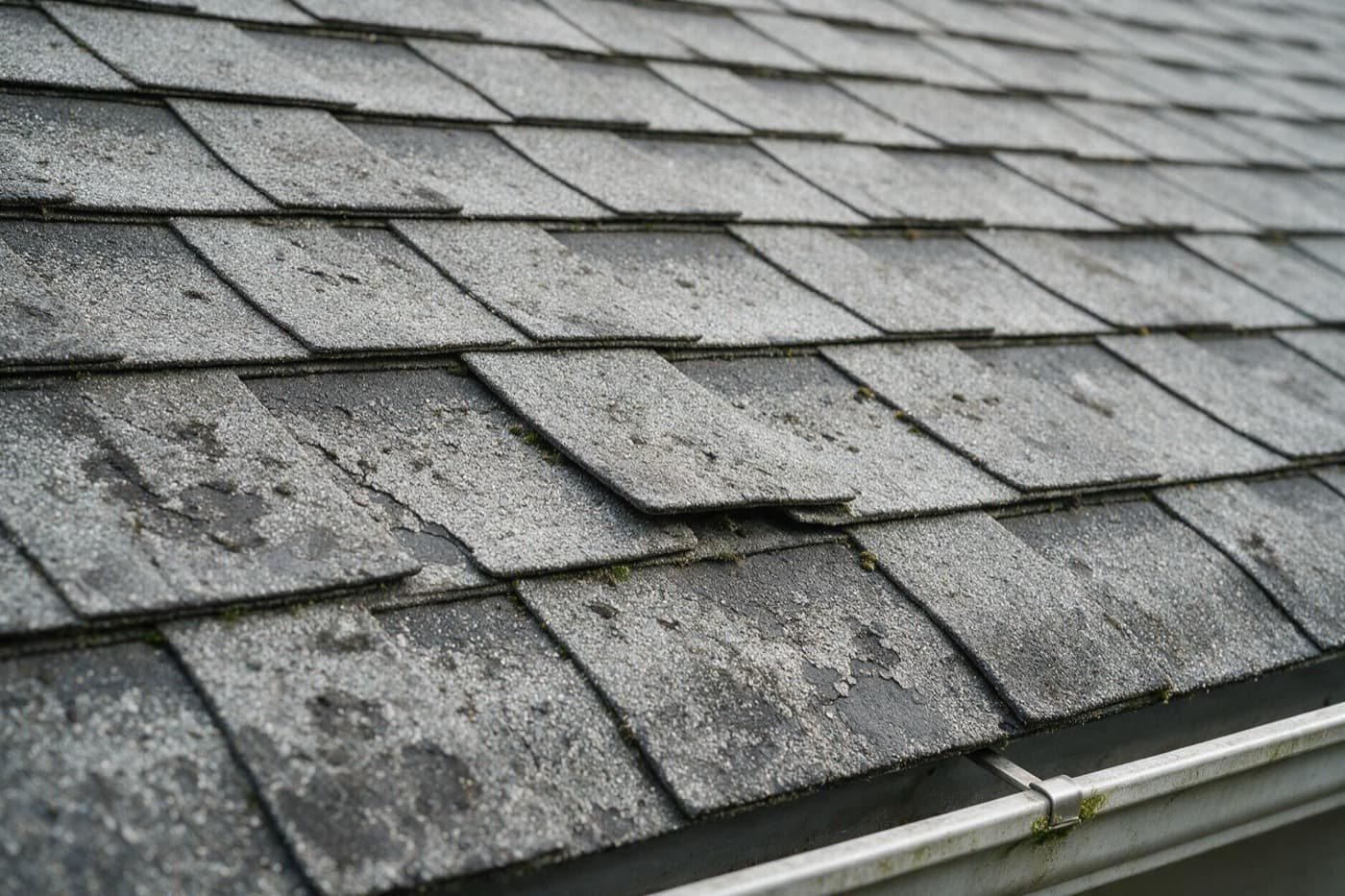
The honest answer is that the number printed on the shingle packaging is close to meaningless in Vancouver.
It is not a lie, exactly. It is a figure established under standardised test conditions, and it usually describes a materials warranty against manufacturing defect rather than a promise of service life. Neither of those has much to do with a roof sitting on a shaded slope in Burnaby getting rained on for seven months a year.
So here are the numbers we actually see, why they land where they do, and how to work out whether your own roof is near the end or has years left in it.
The short answer
Most asphalt shingle roofs in the Lower Mainland last somewhere between 12 and 25 years. The spread is wide because the covering is only one of the variables. Exposure, ventilation and tree cover matter at least as much as the product.
Metal is the exception at 40 to 50 years. Everything else in common use here sits inside that 12 to 25 band, and where a particular roof lands is decided in the first week of its life by how it was installed and ventilated, then in every year after by how wet it stays.
A useful rule: if two roofs on the same street were installed the same week with the same product, the one under trees on a north slope will need replacing years before the one in the open. Age tells you when to start looking. It does not tell you the answer.
Why the rating on the packet does not apply
Vancouver gets around 1,153mm of rain a year. What matters more than the total is the shape of it: months of persistent damp from October through April rather than a handful of heavy storms. Roofs here rarely get properly dry through the winter at all.
That sustained wetness drives two things. It gives moss and algae somewhere permanent to live, particularly on slopes that never see direct sun. And it keeps the shingle mat saturated, which accelerates the loss of the protective granule layer and leaves the asphalt underneath exposed to hardening and cracking.
A shingle rated for 30 years in a test lab is being asked to do something quite different here. That is not a reason to distrust the manufacturer. It is a reason to treat the rating as a comparison between products rather than a countdown timer for your roof.
Realistic lifespans by material
What we see on Lower Mainland roofs, rather than what the packaging claims.
| Material | Realistic life here | Notes |
|---|---|---|
| Three-tab asphalt shingle | 12 – 18 years | The thinnest common covering. Rated for 25 in a catalogue, rarely gets near it here. |
| Architectural asphalt shingle | 18 – 25 years | Heavier mat, better wind rating. The sensible default for most Lower Mainland homes. |
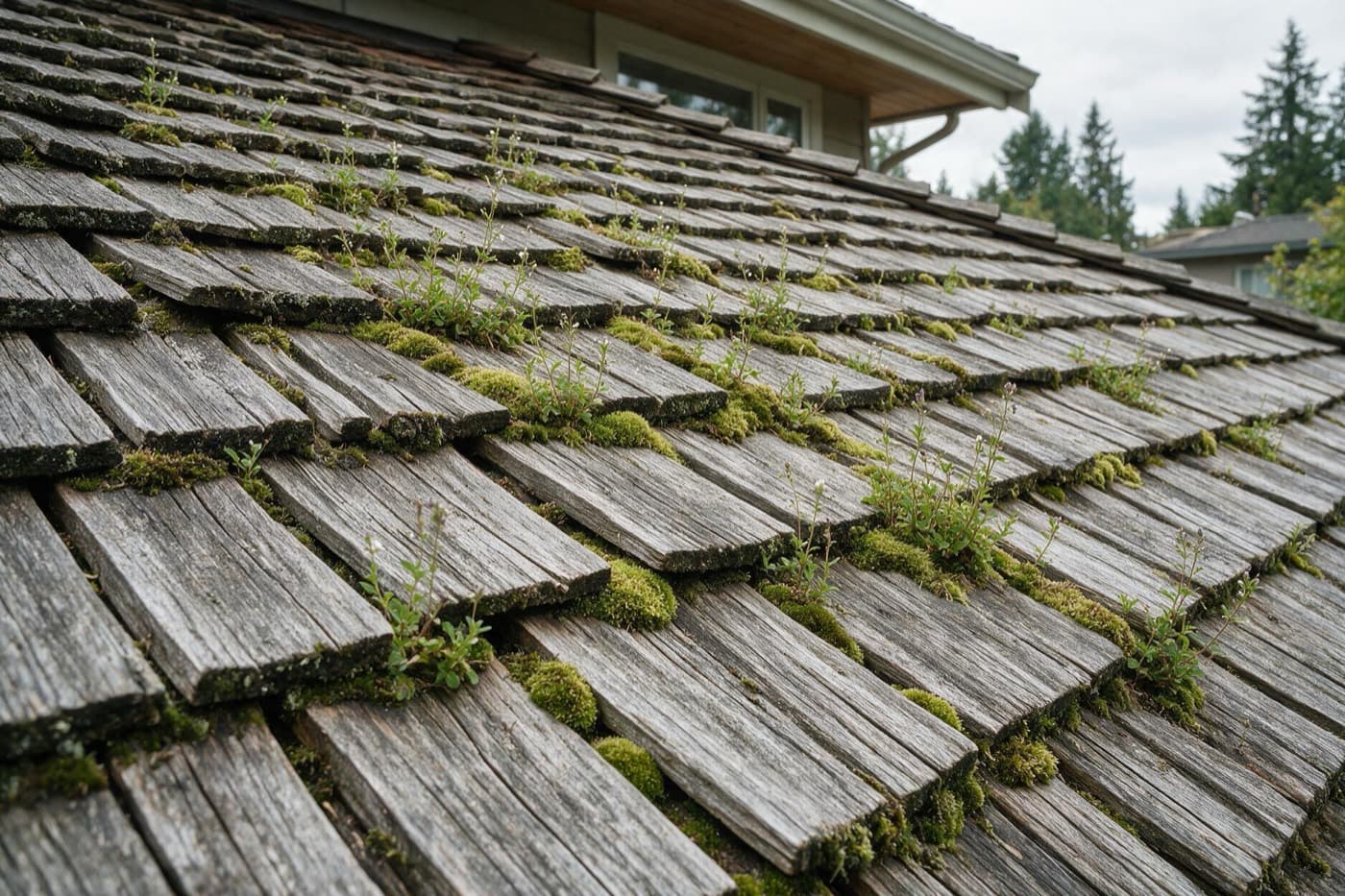
| Cedar shake | 15 – 25 years | Entirely dependent on maintenance. Neglected in this climate it fails at the bottom of that range. |
| Torch-on flat (SBS) | 12 – 20 years | Driven by ponding and seam detail rather than age. Good drainage buys years. |
| Metal | 40 – 50 years | Outlasts everything else. Fasteners and flashing near the coast are the limiting factor. |
Worth noting that cheapest per year of service is usually architectural asphalt rather than three-tab. The saving on three-tab is real, but you buy it back in five or more fewer years of roof and an earlier second tear-off. We go through that trade-off in detail in the 2026 cost guide.
What actually shortens a roof here
Four things account for most of the gap between a roof that reaches the top of its range and one that fails early.
Tree cover
Overhanging branches keep a slope permanently damp, drop debris into valleys and gutters, and give moss somewhere to establish. Two identical roofs on the same street can differ by five years on tree cover alone.
Ventilation failure
The one most homeowners never hear about. An attic that cannot breathe drives moisture up into the underside of the deck, and the roof rots from below rather than wearing out from above.
North-facing exposure
North slopes get little direct sun from October to April. They stay wet, they grow moss first, and they reach the end of their life measurably sooner than the south side of the same building.
Salt air proximity
Near the water in Tsawwassen, White Rock or along Boundary Bay, salt corrodes flashing, drip edge, vents and fasteners long before the shingles are worn out. The metal becomes the limiting component.
Ventilation deserves the extra emphasis, because it is the one nobody inspects from the ground and the one most often missed. A good share of the roofs we condemn early were not killed from above by rain. They were killed from below by condensation, because the attic could not breathe.
Act now or wait?
This is what most people searching the question actually want to know, and the tables above cannot answer it on their own. A fifteen-year-old roof might have eight years left or two.
The useful signals are about pattern rather than age. Damage confined to one area, with the rest of the covering still flexible and holding its granules, points to a repair and several more years. Failures spread across whole slopes, a deck that has softened, or a third repair to the same roof point the other way.
- Inside the ranges above with no symptoms: keep an eye on it, no action needed
- Past the range but sound and dry: annual check, plan rather than panic
- Localised damage, rest of the roof healthy: a repair, not a replacement
- Widespread curling, bald patches or a soft deck: replacement is the honest answer
- Repeated repairs to the same roof: you are spending badly
The full diagnostic, sign by sign, is in how to know if your roof needs replacing. And if what you actually have is a leak rather than a roof at the end of its life, start with roof repair in Richmond instead, because that is usually a fraction of the cost.
Free site visit
The only way to know is to look at it properly
Free site visit, a straight answer on how much life is left, and a free itemised estimate within 24 hours if you need work. If the roof is fine, that is what we will tell you. Serving Richmond, Vancouver, Delta, Surrey and the wider Lower Mainland.
Common questions
Most asphalt shingle roofs in Vancouver and the wider Lower Mainland last 12 to 25 years depending on the product and the exposure. Architectural shingles typically reach 18 to 25 years; the cheaper three-tab product often taps out between 12 and 18. Metal is the outlier at 40 to 50 years.
Manufacturer ratings are established under test conditions, not under 1,153mm of annual rainfall with months of persistent damp. The warranty is also usually a materials warranty covering manufacturing defect, not a promise of service life. A 30-year shingle on a shaded north slope with poor attic ventilation can be finished in 15.
Yes, noticeably. North-facing slopes get very little direct sun between October and April, so they stay damp far longer after rain. That sustained moisture is what allows moss to establish and what accelerates the breakdown of the shingle mat. It is common to see one slope of a roof in visibly worse condition than the other.
Once per covering rather than on a fixed schedule. For a typical architectural asphalt roof that works out to roughly every 20 years, but the honest answer is that condition matters more than the calendar. A well-ventilated roof in the open can outlast a shaded one by five years or more.
Between 15 and 25 years, and maintenance decides where in that range you land. Cedar in a wet coastal climate needs cleaning and treatment to reach the upper end. Left alone it holds moisture, splits and hosts moss, and fails early.
Only roughly. From the ground you can spot missing or curling shingles, moss and a sagging roof line. What you cannot see is the condition of the deck, the flashing detail or the attic ventilation, and those decide whether a roof has three more years or ten. That is what the free site visit is for.